
AI tools are now taking over the world, and two of the biggest names in the industry are ChatGPT and Perplexity AI. A lot of you might have used either of them for information seeking, fact checking, academic research, marketing intelligence, file analysis, focus searching and other such use cases.
However, have you ever wondered how they compare to one another based on their search capability, source citation, content generation and other specialized features? Well, this Perplexity vs. ChatGPT comparison article is all about giving you the efficacy of these tools and in what use cases do they perform the best.
Evident Differences Between Perplexity AI and ChatGPT
Both ChatGPT as well as Perplexity are outstanding AI tools, but they are different in certain ways that can help you decide on their proficiency across different use cases:
Perplexity AI |
ChatGPT |
|
| Models Supported | Perplexity has multiple AI models embedded within, including Gemini, Grok, GPT-4o and some in-house models such as R1 1776 and Sonar. | ChatGPT operates on models including GPT 4.1, GPT 4o, GPT o3 and GPT o4-mini. The GPT4.1 is the free model for users to avail limited features of this AI tool. |
| Quality of Web Search | Perplexity AI features better web search quality, offering quality results. It also supports real-time searches and enables you to focus your search on specific niches including academic papers or global facts. | ChatGPT has a strong search feature but it relies on a fewer sources when compared to Perplexity. In some instances, the search results aren’t accurate. Users will have to continually click on “Search” mode to ensure you are getting real-time results. |
| Multimodal Support | Enables you to execute your search based on image, audio, documents and text. It also has a voice mode that works feasibly well for most queries. However, Perplexity AI doesn’t have a real-time video-driven voice search assistance. | ChatGPT is completely multimodal, enabling users to conduct their search through text, audio input, images, file upload and more. It also has an advanced mode for users to give voice inputs and get voice-based outputs, for anything that they see. |
| Coding & Data Analysis Support | Perplexity AI has a strong coding and data analysis feature. However, the context windows are limited with only a fewer specialized features. This way, Perplexity is less useful with respect to coding and data analysis. | ChatGPT is better in terms of coding and data analysis, capable of handling anything that developers throw at it. If you are using ChatGPT with the most recent reasoning models, the coding efficiency will significantly increase. |
| Pricing | Perplexity has a free access with certain limitations. However, the premium Perplexity Pro plan starts at $20/month, and Perplexity Max plan starts at $200/month. | ChatGPT offers free access with some limitations. The premium ChatGPT Plus plan costs $20/month, whereas ChatGPT Pro costs $200/month. |
Understanding Perplexity AI
Perplexity is a popular AI search engine, also referred to as an AI chatbot, created for providing users with accurate & comprehensive answers as response to their queries. It is powered with NLP and ML which enables the tool to deliver real-time and updated information across diverse topics. This tool also provides users the sources it retrieves the information from.

Key Features:
-
Real-Time Web Search:
Perplexity supports real-time web search capabilities enabling users with the most recent information available on the internet.
-
3D Capture & Texture:
It helps you create code, derive research solutions to mathematical equations, summarize texts and write tables, all by understanding complex queries.
-
Source Citations:
Perplexity AI lists out the citations to every response it generates, ensuring users can seamlessly trace the actual origin of a particular information.
-
Pro Search:
Perplexity AI enables users to leverage the potential of Claude 3 and GPT04 LLMs, through the Pro plan of this AI tool, which will enhance the overall research experience.
Understanding ChatGPT
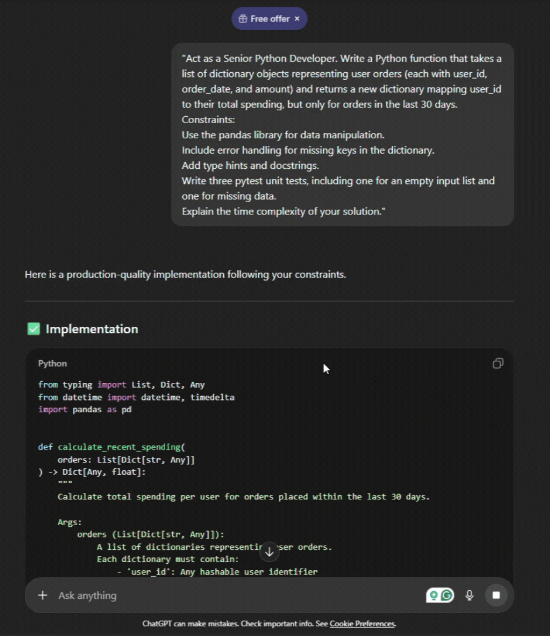
ChatGPT is one of the most popular AI tools that exist, built by OpenAI. It has been revolutionized by conversational AI, which helps the model understand human text and generate responses in a similar tone. One among the brilliant features of ChatGPT is, it offers contextually relevant and coherent dialogue for keeping the users engaged, irrespective of the search topics. The capabilities of ChatGPT has now expanded to processing audio, voice and image inputs, which makes the AI tool more conversational and versatile.
Key Features:
-
DALL-E Integration:
ChatGPT supports integration of DALL-E’s image generation feature, enabling the tool to create detailed visuals through users’ textual inputs.
-
Multimodal Capabilities:
ChatGPT has the ability to process & generate responses from text, audio and image inputs, offering an interactive & engaging experience.
-
Code Generation:
ChatGPT supports coding functionality, enabling developers to generate code snippets for software projects of almost all types.
Perplexity AI vs. ChatGPT: When Should You Use Each Tool?
Even though you are now well-versed with the efficacy of Perplexity AI and ChatGPT, only one among the two might seem ideal for your tasks at one point of time. You ought to understand the use cases of both Perplexity as well as ChatGPT which will help you benefit the most out of each tool:
When to Use Perplexity?
Perplexity is considered better in situations where search queries demand utmost accuracy and source verification. The research-first approach of the platform makes it immensely valuable for professional and academic work. Perplexity is best suited for:
- Academic research that requires source citation.
- Fact-checking of current claims or events
- Deep analysis of the complex topics
- Content requiring source attribution
- Conducting industry and market research
- Comparing different topic perspectives
When to Use ChatGPT?
ChatGPT is better in scenarios where a conversation and flexible approach is entertained. The ability of this AI tool in switching between different tasks while adhering to the context, makes it quite valuable for diverse work sessions. ChatGPT is best suited for:
- Content generation and creative writing
- Assisting with generating and debugging code
- Brainstorming unique business ideas and ideating on them
- Creating eductional tutorials and explanations
- Analyzing and processing audio and images
ChatGPT vs Perplexity: Which is the Best?
Both ChatGPT and Perplexity are best in their respective use cases. Perplexity is better used for research-intensive tasks such as fact-checking or academic works that require clear source attribution, whereas ChatGPT is best for technical and creative tasks like coding, brainstorming business ideas and more.
Instead of viewing these two AI tools as rivals, users can often benefit by using them as complementary tools used for different purposes or tasks. The research strength of Perplexity combines well with the versatility of ChatGPT, enabling users to pick the right tool based on their different needs or interests, serving a single purpose.